- Woodland Historic Cemetery & Aboretum -
Dayton, Ohio
Dayton, Ohio
Date: 7.28.13
VOLP Investigators Attending:
Victor, Garry, Johnathan, Shelly, Ericka, Betsey, & Cody

"From Woodland's Lookout Point - the highest point in the city - Dayton's skyline far surpasses the dreams of John Van Cleve, one of the city's important leaders and Woodland's founder. By the 1840s, Dayton was outgrowing its original cemetery at Third and Main Streets. Dayton's pioneer families faced the problem. The village was growing and a larger, more suitable cemetery was needed, preferably on some of the beautiful wooded and rolling land with which Dayton was surrounded. Selecting from thousands of available acres, the original trustees, led by John Van Cleve, chose 40 acres remarkable for their hilltop views and their wide variety of trees. Opening in 1843, it was for that natural beauty that they chose to call it "Woodland." At that time those acres seemed quite far from the center of the little city. Little did they know that, in the decades to come, Dayton would reach out to Woodland and then surround it on all sides.

"In those days, Ohio was most popular for settling because of the value of our farm products. Southwestern Ohio had very good farms and had the largest Ohio city, Cincinnati, with a population of over 100,000. Dayton had about 20,000 people, one out of every four being foreign-born, mainly Irish and German, who had come to build the Miami-Erie Canal in the 1850s. Half were Ohio-born, with a few African-Americans. Dayton was already becoming industrial with the Barney & Smith Car Works, a leading producer of railroad cars. Streets were dirt, often mud, with wooden sidewalks. The Courthouse downtown was the best building there. It was built in the 1840s.
 "In early times, many children died before they were 10, women died in childbirth and epidemics often killed several members of the same family. The cemetery was a place to "talk" to the deceased while honoring them with flowers. Family picnics were commonplace in large, park-like cemeteries. The park-like cemetery remained popular until about World War I. By that time, many diseases had been conquered and early deaths of family members were less common. Cemeteries were rarely visited and often neglected.
Today, Woodland's 200 acres make up one of the nation's oldest "garden" cemeteries. Its Romanesque gateway, chapel and office, completed in 1889, are on the National Register of Historic Places. The chapel has one of the finest original Tiffany windows in the country. 100,000 monuments, ranging from rugged boulders to Greek statues and temples, note the lives of people who helped to shape a young nation and a young city. With more than 3,000 trees on its rolling hills, Woodland is recognized as one of the area' finest arboretums. Many of its trees are more than a century old. Having burial space for many years to come, Woodland offers several types of burial services. In the Garden of the Soaring Spirit, lawn crypts provide the advantage of a modern memorial along with a smaller burial space."
*~*
- Famous Faces Buried in Woodland Historic Cemetery & Arboretum -
 Daniel C. Cooper( 1778-1818), more than any other person, deserves to be called the founder of Dayton. He was a surveyor acting under orders from Gen. Arthur St. Clair, governor of the Northwest Territory; Gen. Jonathan Dayton; Gen. James Wilkinson; and Col. Israel Ludlow. He led a surveying party to the mouth of the Mad River. Here he laid out the city with broad streets "four poles wide" and built most of its early mills, naming it after General Dayton with streets named after the other three. Can you find those streets on a map of downtown Dayton? Cooper served as Dayton's first justice of the peace and as a member of the state legislature.
He also donated ground for a cemetery, churches, and schools as well as for the present Cooper Park next to the downtown branch of the Dayton-Montgomery County Public Library. He strained himself while moving a church bell, leading to his death in 1818.
 Adolph Strauch (1822-1883), The 105 acres that comprised the 1912 borders of Woodland were declared a "Historic District" by the U.S. Department of the Interior on November 22, 2011 and placed on the National Register of Historic Places, due in large measure to the genius exhibited within it's landscape design. In the 1870's, Woodland commissioned the Landscape Architect Adolph Strauch from Spring Grove Cemetery in Cincinnati to re-design the cemetery. By combining the natural landscape with a "curvilinear design", Strauch provided vistas, grand views and a focus on memorialization never before envisioned, and helped to launch the new Rural Garden Cemetery movement nationally.
In addition to the design expertise Mr. Strauch brought to Woodland, he also designed Spring Grove Cemetery and planned numerous parks in Cincinnati (Eden Park, Burnet Woods, Lincoln Park) while expanding rural cemetery design concepts to Hartford Cemetery in Connecticut; Forest Lawn in Buffalo, New York; Highland Cemetery in Covington, Kentucky and Woodmere Cemetery in Detroit, Michigan. One need only drive or walk through any of these properties to appreciate the genius Adolph Strauch brought to both Woodland and the new field of cemetery design architecture.

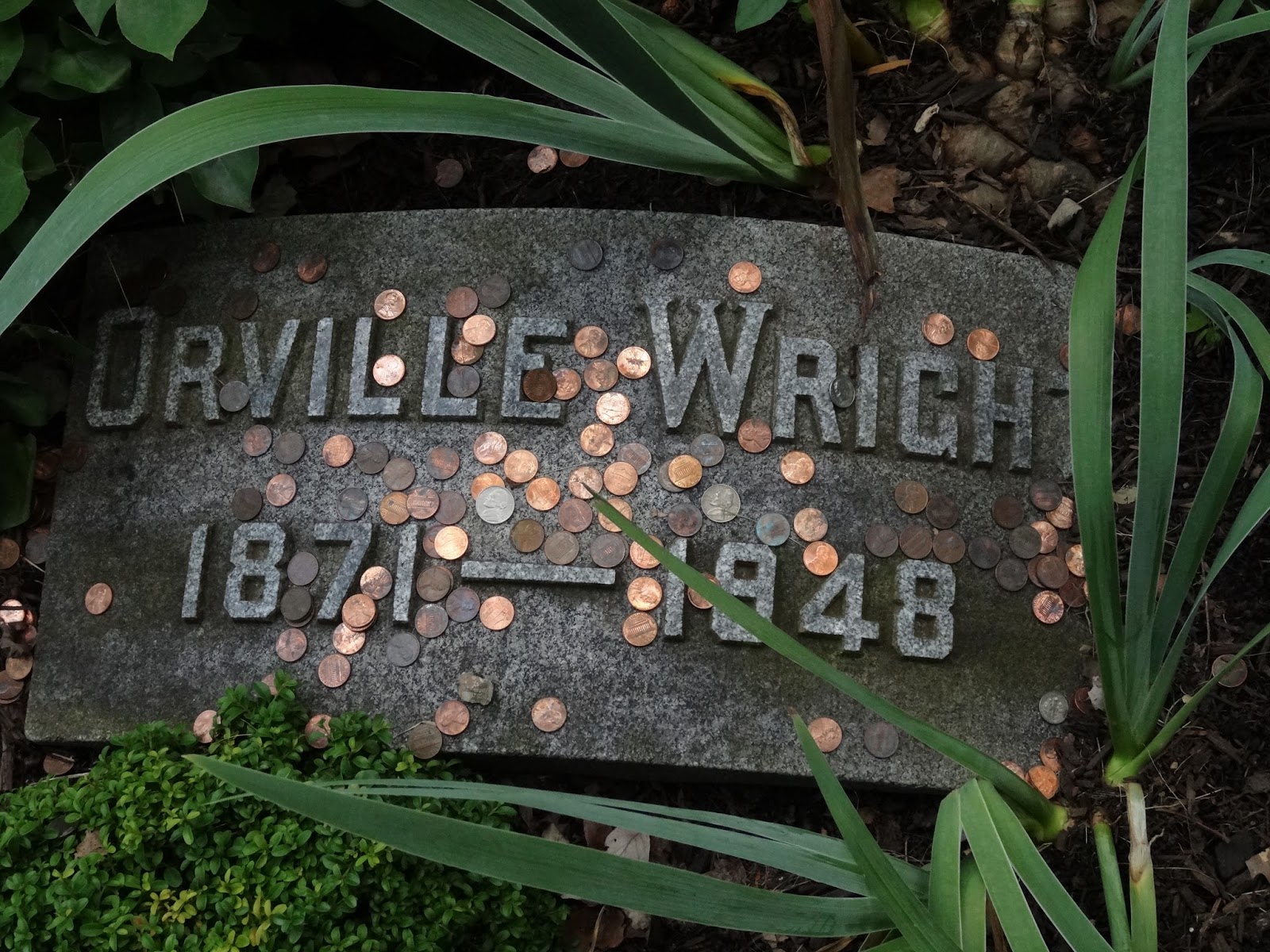
Wilbur & Orville Wright (1867 - 1912, 1871 - 1948), Two famous brothers, Wilbur in 1867, and Orville in 1871, were born to Susan and Milton Wright. Their younger sister came along later. You may see all of their gravestones in a family group at Woodland. The Wright brothers became interested in a "self-propelling toy"brought home by their father to "relieve their boredom." The boys were voracious readers, reading every book on flight or machines available. They were also serious observers, questioning and testing how things around them worked. They made simple mechanical toys, and in 1888 they built a large printing press that they used to publish the West Side News in Dayton.
Already successful printers, the brothers opened a bicycle repair shop in 1892. In that shop on West Third Street, they worked with tires, wheels, and air pumps, and dreamed that man could fly in a heavier-than-air machine. They tested the effects of air pressure on more than 200 wing surfaces using the first wind tunnel. Through their own research, they learned scientific facts and developed theories of flying. Their invention of aileron control, helped them in 1903 to build and fly the first power-driven, man-carrying controllable airplane.
They chose the windiest place, Kitty Hawk, NC, and made their machine (750 lbs.) stand up under the wind and stay in the air for 59 seconds. They continued on to set new distance and altitude records for flight. Wilbur died of typhoid fever in 1912, while Orville lived on until 1948. As scientists they had uncovered the secret of flight. As inventors, builders, and flyers, they brought aviation to the world.
 Paul Laurence Dunbar (1872 - 1906), born poor and black in 1872, was a man who turned his imagination into prose and poetry. His father, who died when Paul was 10, was a slave who escaped to freedom in Canada. His mother, also a slave, lived in Kentucky before the Civil War. He developed a love for literature when he spent evenings reading aloud to his mother, which she dearly loved. A classmate of Orville Wright, Paul was the only Black in his Central High School graduating class in Dayton. He was one of the first Black writers of his time to get national attention. In poems, he was able to tell of daily Black life, using the Southern Negro dialect. He published his first book of verse, Oak and Ivy in 1883.
As his fame grew, he gave readings before audiences all over the United States and in England. In all, he wrote 25 books, 15 essays, over 100 poems, 35 song lyrics, 24 short stories, nine musical shows, and four plays. When he died of tuberculosis in 1906, the world lost a true giant. His tombstone along the roadside at Woodland is overshadowed by a willow tree planted there. That tree refers to a poem by Dunbar called A Death Song. The first verse is on his stone, but there were two more verses. The second verse describes a lake that is now filled in. A stained glass window in the Dunbar room of Woodland Mausoleum shows the view explained in that verse.
A Death Song

Lay me down beneaf de willers in de grass,
Whah de branch 'll go a-singin'
as it pass.
An' w'en I's a-layin' low,
I kin hyeah it is as it go
Singin', "Sleep, my honey, tek yo' res at las'."
Lay me nigh to whah hit meks a little pool,
An' de watah stan's so quiet lak an' cool,
Whah de little birds in spring,
Ust to come an' drink an' sing,
An' de chillen waded on dey way to school.
Let me settle w'en my shouldahs draps dey load
Nigh enough to hyeah de noises in de road;
Fu' I t'ink de las' long res'
Gwine to soothe my sperrit bes'
Ef I 's layin' 'mong de t'ings I's allus knowed.
Whah de branch 'll go a-singin'
as it pass.
An' w'en I's a-layin' low,
I kin hyeah it is as it go
Singin', "Sleep, my honey, tek yo' res at las'."
Lay me nigh to whah hit meks a little pool,
An' de watah stan's so quiet lak an' cool,
Whah de little birds in spring,
Ust to come an' drink an' sing,
An' de chillen waded on dey way to school.
Let me settle w'en my shouldahs draps dey load
Nigh enough to hyeah de noises in de road;
Fu' I t'ink de las' long res'
Gwine to soothe my sperrit bes'
Ef I 's layin' 'mong de t'ings I's allus knowed.
-Paul Laurence Dunbar

John H. Patterson (1844 - 1922), After a short experience as a teacher, John H. Patterson worked as a toll collector on the Miami-Erie Canal, which ran along the present Patterson Blvd. across from the library. He soon began with his brother, Frank, a business of selling and mining coal. The general store they owned did a good business, but at the end of two years, the owners found there was $3,000 missing. Clerks had stolen from the cash drawer. After buying three Dayton-made cash registers, Patterson's business began making money, a profit of several hundred dollars. He created a demand for cash registers and began selling them everywhere.
His company, presently named NCR (National Cash Register), now sold more of the machines. At the same time, Patterson's work to improve factory working conditions, build a recreation park with pool, provide a lunchroom, increase lighting, and train apprentices was the talk of the business world. His NCR factory was booming when Patterson looked out his factory window at the deep floodwaters covering the streets of downtown Dayton. He immediately ordered an immense amount of wood, so his employees could build boats to save people caught by swirling waters from their second floor windows. He was the hero of Dayton?s 1913 flood. He is remembered today not only for the humanitarian way he operated his factories, but for instituting Dayton's present form of city government with a city manager as its head.
 Charles F. Kettering (1976 - 1958), was born in the small, north-central Ohio town of Loudonville. At age 28 he came to Dayton from college to take a job at the National Cash Register Co. In five years, he did much to help NCR's development. Then, along with Edward Deeds, he formed the Dayton Engineering Laboratories Co. (DELCO).
Kettering and Deeds had been doing some experimenting with a single-spark auto ignition in Deeds barn. Out of the laboratory came the first electric self-starter and an all-electric ignition system eliminating hand-cranking a car to start it. Kettering was friends with other inventors such as Thomas Edison (light bulb, phonograph) and Henry Ford (first mass-produced cars). Ford put Kettering's discovery into his early Fords. Kettering's example led hundreds of research men on to daily scientific discoveries. In his earlier research, he also developed the independent electric generator that brought power and light to thousands of farms everywhere.

Col. Edward A. Deeds (1874 - 1960), (Image courtesy of the Miami Conservancy District) Col. Edward A. Deeds worked as an engineer at NCR for years and formed a partnership with Charles F. Kettering. They and other inventors met as "The Barn Gang" in Deeds' barn to develop new ideas. They electrified the cash register and formed DELCO. In addition to his work in research and development, he had a keen sense of responsibility to his community. As organizer of the Miami Conservancy District, he did much to bring flood prevention to Dayton after the disastrous flood of 1913. Deeds' Carillon Bells and Carillon Park were given to Dayton through the generosity of Colonel and Mrs. Deeds. His is the largest private mausoleum on the grounds of Woodland Cemetery.
 C.J. McLin, Jr. (1921 - 1988), Born in 1921 in Illinois, C.J. McLin was the son of hard-working African American parents trying to survive the Depression. When they moved to Dayton in 1931, he took a job as a paper boy as a way to put food on the family table. While going to Dunbar High School, he helped in the family funeral home business. He suffered racial discrimination early in life, being denied food service at the lunch counter in McCrory's dime store near 4th & Main Streets, downtown. He filed a lawsuit demanding his civil rights. Soon after, he received notice that he must go into the Army. During his three years of service, he noticed and experienced discrimination against Black soldiers.
He organized and participated in many protests to obtain rights both in the military and later in political life. His father had taught him how important funerals were to families of the deceased. These ceremonies helped them cope with the death. When he was dismissed from the military, he returned to the family funeral business in 1949. Because he longed to empower Black citizens, he began to work at electing Black citizens. He himself was elected to the Ohio House of Representatives in 1966 where he served Daytonians for 22 years. During his time in the legislature he did many things to increase to political power of the Black community of Dayton through economic development. He was responsible for extending its highways (US Route 35W), locating the correctional prison there, supporting programs in its universities, housing its elderly, and saving its history (Dunbar House, National Afro-American Museum). His daughter, Rhine McLin, has followed her father's footsteps into politics. In that way, his service continues.
*~*

Woodland Historic Cemetery & Aboretum
Dayton, Ohio
Date: 7.28.13
VOLP Investigators Attending:
Victor, Garry, Johnathan, Shelly, Ericka, Betsey, & Cody
Photos from our tour from this point forward....
Photos from our tour from this point forward....


Above: An aerial view of the absolutely massive, 200-acre Woodland Cemetery & Arboretum.
*~*
First stop...


"When I stand before God at the end of my life, I would hope that I would not have a single bit of talent left, and could say, 'I used everything you gave me'." - Erma Bombeck
The notoriously loved and respected Erma Bombeck is buried in an unmarked location behind this boulder (pictured below).
"A 29,000-pound rock has become a monument for writer Erma Bombeck's grave. The massive rock was brought here by flat-bed truck from near her former home in Arizona. Her husband, Bill Bombeck, said he wanted a "piece of Phoenix" at Erma's grave to commemorate the 25 years they spent together in Arizona.
 Born Erma Louise Fiste in 1927 in Dayton, Ohio, she worked for a daily newspaper while in high school and while attending the University of Dayton. After graduating she became a reporter for the Dayton Journal-Herald (which later became the Dayton Daily News), where she also wrote feature stories and a housekeeping column for the women's page, continuing until the birth of her first child in 1953. By 1964 she was the mother of three, and returned to her column appearing in more than 800 newspapers. Her witty-but-wise columns poked fun at family life from her place as a suburban housewife. One of her six best sellers won the American Cancer Society's Medal of Honor in 1990 for advice to help children survive cancer. This internationally read humor columnist died of complications following a kidney transplant operation in 1996."


Above: For a mere $325,000 this could be your final resting place.
*~*
Infamous Grave Sites...
 "In the 1860s there was a boy, Johnny Morehouse, the youngest son of John and Mory, who lived with them in the back of his father's shoe repair shop. One day the five-year-old was playing near his home by the edge of the Miami & Erie Canal (which used to run along the present Patterson Blvd. in downtown Dayton near the library).
The boy accidentally fell into the canal water. His dog, playing by him, jumped into the water and tried to save him. He pulled the boy out, but not in time to save his life. The boy drowned and was buried in Woodland Cemetery. Legend has it that, several days after the burial, the dog appeared next to the boy&apo's;s grave staying by it morning, noon, and night. Visitors to the cemetery saw him and began to worry about his health. Some began leaving him bits of food. Passersby still bring small toys and other trinkets to decorate the grave marker to express their spontaneous outpourings of sympathy. Some visitors put money there. A lady who walks the cemetery every day collects the money and buys something for the grave often. As you can see on his grave marker, he already has toys to play with - his harmonica, his top, his cap, his ball."
*~*


A little side story...
About halfway through the tour, we quite literally reached a crossroads. We had five options as far as which path to go to continue on in the cemetery. The four mediums (Victor, Garry, Shelly, & Cody) happened to be standing together in a little group, and when asked 'which way should we go?' ... literally all four of us pointed and said out loud, "That way!"
It was quite the moment! We had a good laugh, and wished several times we had caught that moment on camera - it was classic!


*~*

Above & Below: Within this tomb lies the body of the man responsible for the phrase, "You're fired!" And no, we're not talking about the guy with the crazy hair and more money than any one person should have - This is where JAS Ritty, who invented the cash register because he was tired of his bartenders stealing money from him.
 Personal Story from Garry Fox, VOLP Medium: "I did have an experience at the tomb that you have a pic of me touching the door of. I was seeing men go in there with top hats on ducking down and out of respect placing their hats on a shelf directly to the left of inside the door. I felt like the man who owned the family tomb was known for his top hats. John Powers (our tour guide) stated that during the reenactment that had taken place there before on a lantern tour of the cemetery that the actor that played this man had on a top hat. I believe he invented the cash register that was used to keep bartenders honest. Every time they sold a drink a bell would ring when the cash drawer was opened so he could watch the transaction. I believe this is what John said about him. He was known to sport a silk hat according to articles I found in and out of his bar but not a top hat. But he was known for a hat trademark. I guess I should have said a silk hat instead assuming it was a top hat. But John did say the reinactor wore one so maybe the message was that there was a hat trademark for him and the actor got it wrong!!"
*~*


Above: We thought this one was particularly interesting. We've heard of having a 'right arm' (as in someone who helps you, best friends, etc.)... but a 'left arm'..? Well, apparently this person was the 'left arm' of the person buried to the right of them.

*~*

Above: A creepy story for you... our tour guide, John, informed us that in this particular gravestone when it's dark out (night time) you can clearly see a not-so-happy face of a man within the weeping willow tree on the right. Below is a close-up of the area the face is seen.

*~*

*~*

Above: This particular one caught my interest in a big way. I could feel the energy within this stone angel. As I stood below her gazing up at her face, I felt as if she would turn and look at me at any moment.
Look closely at the statue. Get the reference? She's holding a cloth in one hand, and a 'slate' in the other. She's "wiping the slate clean" of the person who is laid to rest here before they enter the gates of heaven.

*~*
(My personal favorite!) In 1856, Owen Stanley, king of gypsy tribes in England, came to the U.S. with many of his group because England was so thickly populated. He wanted to make Dayton his permanent home. He bought land in the City of Dayton as well as Harrison, Wayne, Mad River, and Butler townships so they could raise horses and winter there, renting out their farms while they took to the road as soon as the weather became warm.

Gypsies were a group of nomadic people whose ancestors are said to have originated in Eastern Europe. Within their groups they have rulers, sometimes women, who decide what is best for their tribe. British gypsies had so many kings and queens - from King John Bucelle in 1657 down to the Gypsy Queen of the U.S., Matilda Stanley, royally buried at Woodland Cemetery in 1878. It is rare that such royalty would be buried here, or that an American clergy would preach at the funeral of a queen, but that happened.
 Queen Matilda had died of cancer in February. Her husband, Levi Stanley, son of Owen Stanley, sent her body to Woodland to be kept in a vault for burial in September. Newspapers here and in many large American cities sent special reporters who printed long columns of accounts before and after the funeral. The Sunday of the event, thousands of people came in from surrounding places by special trains. An estimated crowd of 25,000 swarmed over the avenues and grounds of the cemetery. Police were needed to make way for the funeral procession. The newspaper said a procession of 1000 carriages began downtown and was so long it had to be refused admission at the cemetery gates. Around the gravesite there were so many people that the minister had to deliver his sermon while standing on a wooden plank laid across the open grave under an umbrella in the rain. The king and his tribe, being heartbroken, stayed around the Queen?s still open grave as the great crowd left. Her younger daughters were so upset that they jumped down into the grave onto the marble slab to be closer to their mother and sobbed tenderly.
A granite monument marks the grave of King Levi and Queen Matilda Stanley. Funerals of the Stanley gypsies were quite elaborate. They spared no expense to give their loved ones dignity and show their regard for the dead. The funeral coaches, the undertaker's hearse, a long procession, a rich casket, and a great profusion of flowers were all a part of the event. The women came dressed in their best silks, satins, or velvets. Their fingers were adorned with much gold. The gypsy woman who possesses money does not hesitate to buy expensive things when she has set her heart on them. When you visit the Stanley graves, look for the messages and verses carved on their slabs, called ledgers.
*~*

Above: Another reference... understand it? Little lamb. This is the tombstone of a 2 year old girl, Lucille.
*~*

Above: "Preserved Smith." That's 'pre-serv-ED.' As the story goes, there was a shipful of immigrants traveling to America that encountered a wicked storm. The people on the ship prayed and prayed for the safe passage of the men, women, and children on board. Immediately after praying, the storm eased up. The women on board then vowed to name every child born from that ship "Preserved" because God had preserved their lives. Preserved Smith had many children, and they all do, in fact, carry the name 'Preserved' somewhere within their names, whether it's as a first or middle name.
*~*

Above: Ericka peeks inside the tomb of W.S. Hawkins; the reason we were being nosey is because in the back of the mausoleum there above head-height, there was a beautiful stained-glass window of a landscape scene - if you peeked through the broken glass doors in the front of the mausoleum (as Ericka is so beautifully demonstrating!) - the sun shining through the stained glass window in back was just absolutely breathtakingly gorgeous.
*~*

*~*

*~*
 This is a life-size monument of Gustav Wiedeke, Sr. Wiedeke was a famous tool inventor. His statue/monument sits on top of a hill which overlooks an area of the cemetery where our tour guide, John, had a bit of an eerie, possibly paranormal encounter. He was walking the grounds of the cemetery directly in front of Mr. Wiedeke's monument one night with a few other people when they heard a murderous scream come from right next to them, followed by a disembodied laugh. Needless to say, they fled the cemetery, but received a message from a friend the next day asking them to check that specific area they had been in and heard the scream for a rabbit carcass. Sure enough, when John went back they found a ravaged rabbit carcass. Apparently when rabbits are hunted, they give out one last treacherous "scream" as a defense mechanism. A fox, or something of the like, must have gotten ahold of the rabbit as John and his friends were turning this same corner, hence the scream they heard.
... but the laugh that followed? Personally, I think it was Mr. Wiedeke having a bit of a laugh at them for running terrified from a dead rabbit. ;)
*~*

This is the largest mausoleum at Woodland Cemetery. Look to the right - that's Victor in the white shirt standing next to it (looking up at it) to give it a bit of a perspective.
*~*

 Charles Goodwin Bickham (August 12, 1867, Dayton, Ohio – December 14, 1944, Dayton) was a United States Army first lieutenant received the Medal of Honor for “distinguished gallantry” on May 2, 1902, in the Battle of Bayang, during the Philippine-American War. Lieutenant Bickham carried a wounded soldier across a "fire swept field".
He served as a Colonel on the staff of Ohio Governor William McKinley. During the Spanish-American War, he served as a Private in Company G, Third Regiment, Ohio National Guard, and later a Captain in the Ninth Regiment (Immunes), U.S. Volunteer Infantry. He served as a Captain during the Philippine-American War in the Twenty-eighth Regiment, U.S. Volunteer Infantry, under Col. William E. Birkhimer. After receiving his commission in the regular army as a Lieutenant, he served again in the Philippines with the Twenty-seventh U.S. Infantry under then-Captain John J. Pershing.
 After twice failing the professional examination required for promotion to captain, in 1909 and 1910, he was honorably discharged from the army in June 1910. He never married.
He died December 14, 1944 and is buried in Woodland Cemetery and Arboretum Dayton, Ohio.[2] His grave can be found in section 101, lot 1420.
*~*

Above: The second tallest monument at Woodland Cemetery. It was once taller, actually, but lightening struck a tree, which in turn fell onto the monument. The cemetery crew were able to salvage the monument back together, but it is now a bit shorter than it was originally.
*~*

Above: The tallest monument at Woodland Cemetery, belonging to John Alexander Collins. The plaque on the monument reads, "John Alexander Collins, born in Staffordshire, England, June 8, 1815, came to the United States in 1825. Was a locomotive engineer moved to Ohio in 1851 to open the Railroad. Remained with the -- until 1872. Died in Covington, Ky, January 26, 1878.


*~*
- The Wright Brother's Family Plot -




*~*


Above: Take note of the symbolism with this one (the covered cup), and many of the other beautiful monuments at Woodland Cemetery. The mother & child's face are turned because public displays of grief were frowned upon in those days.

Above: Our fantastic tour guide, John, doing what he does best!

*~*

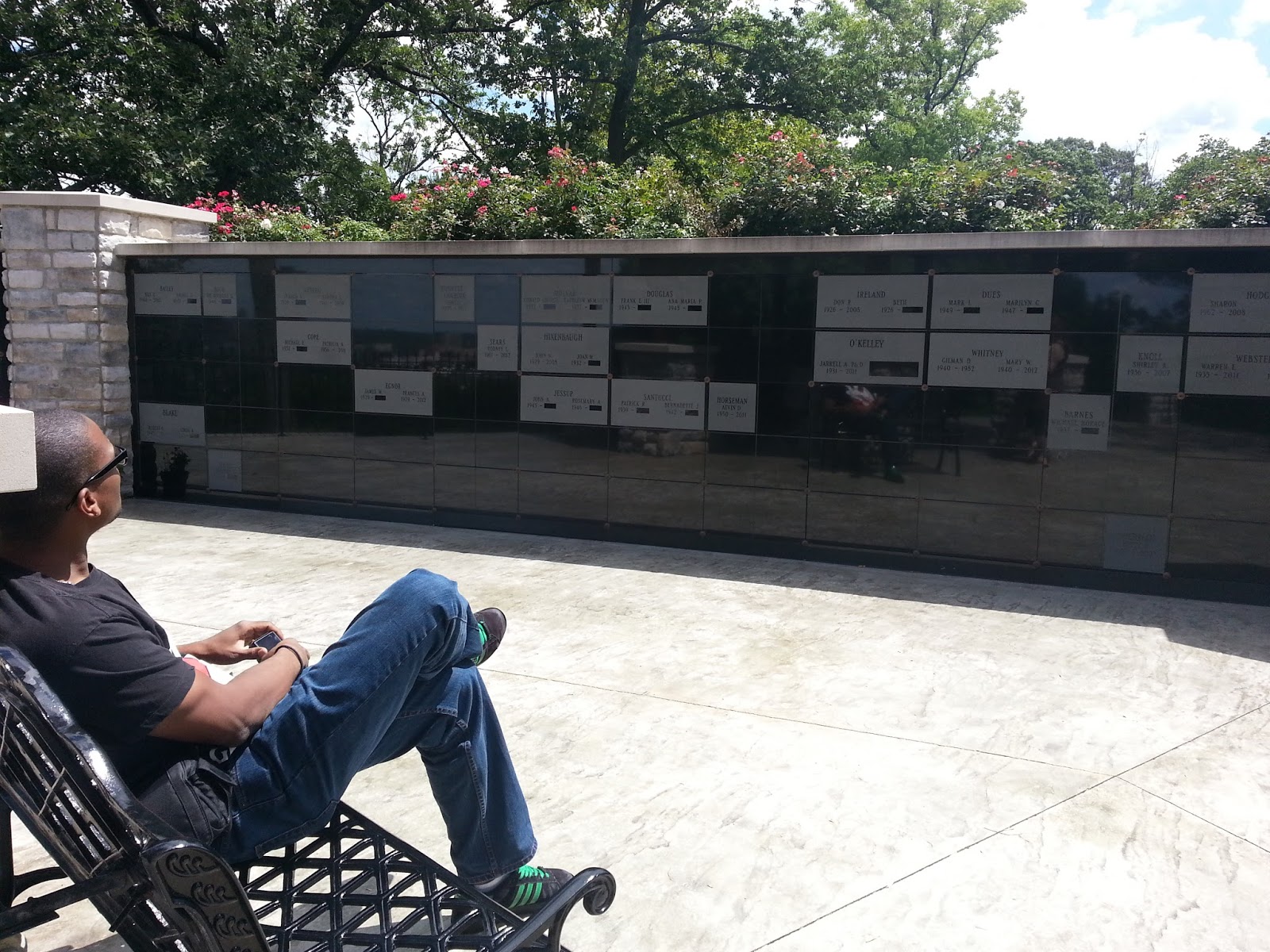
The tallest point in Dayton, Woodland's Lookout Point. The view was absolutely breathtaking. You could clearly see all of Dayton, and the surrounding towns. John & Gayle said the view in the fall with all the foliage gone is even more spectacular - I can only imagine.


*~*


Above: Another interesting story. Look closely, see where it says "VIOLENCE"..? Originally it said, "MURDERED," but the cemetery thought that it was too negative to have so plainly etched into the headstone, so they changed it to "VIOLENCE" instead.
*~*

Above: This unusual beehive, or skep, is a monument marking the final resting place of Daniel Beckel, who lived from 1814 to 1862. Daniel helped to start the first Dayton bank. He was also the builder of the Beckel Hotel and Opera House, a popular entertainment center in Dayton in the mid 1800s. In funerary, or monument art, a beehive represents having good character and promising "abundance in the Promised Land." There is no other connection to beehives known in Daniel Beckel's life. (Source: http://www.woodlandcemetery.org/~woodland/gravestone-stories)
*~*

Above: This is the plot of land where soldiers from four of our wars are buried; the Civil War, WWI, WWII, and Desert Storm. John was unable to confirm if any Iraq veterans are buried here, but he said his info may also be a bit outdated.


*~*


VOLP would like to extend our deepest gratitude and heartfelt thanks to John Powers and his sister Gayle Allcorn for providing our amazing tour of Woodland Cemetery & Arboretum.
We had an absolutely amazing time, and we are all very aware that we aren't exactly the easiest group to be a tour guide for! As Garry let John know relatively early on, we had four mediums on the tour (of a cemetery, mind you), so we were wandering all over the place while poor John was trying to keep the sheep herded together.. haha! We love ya, John! Thanks for putting up with us!
- Shelly, VOLP